AcroRL: Learning Aggressive Quadrotor Inversion using Bidirectional Thrust

Carnegie Mellon University
AcroRL: Learning Aggressive Quadrotor Inversion using Bidirectional Thrust

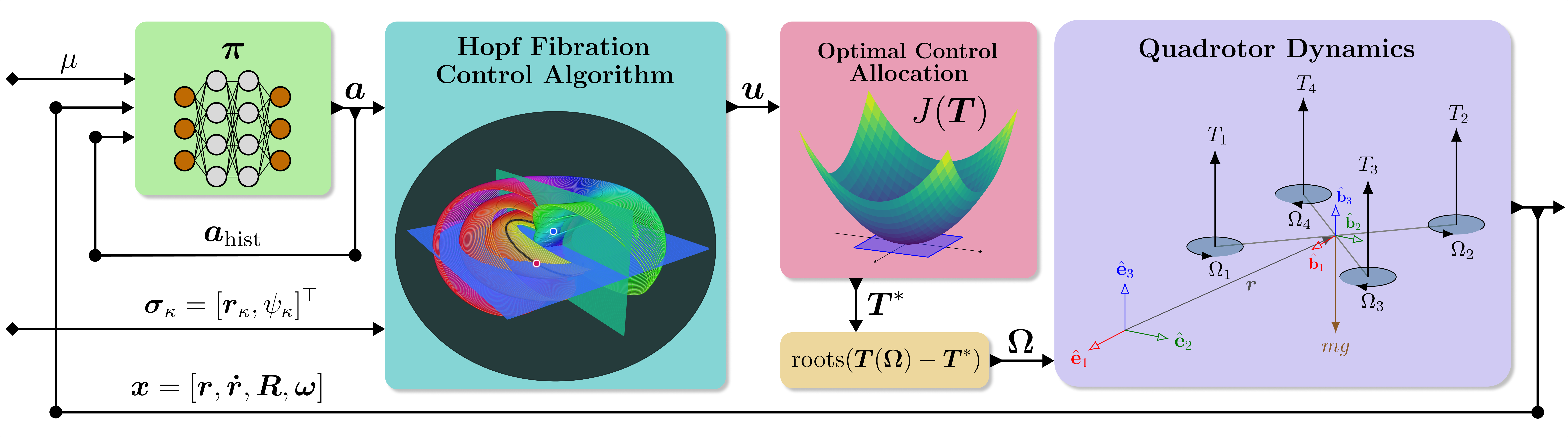
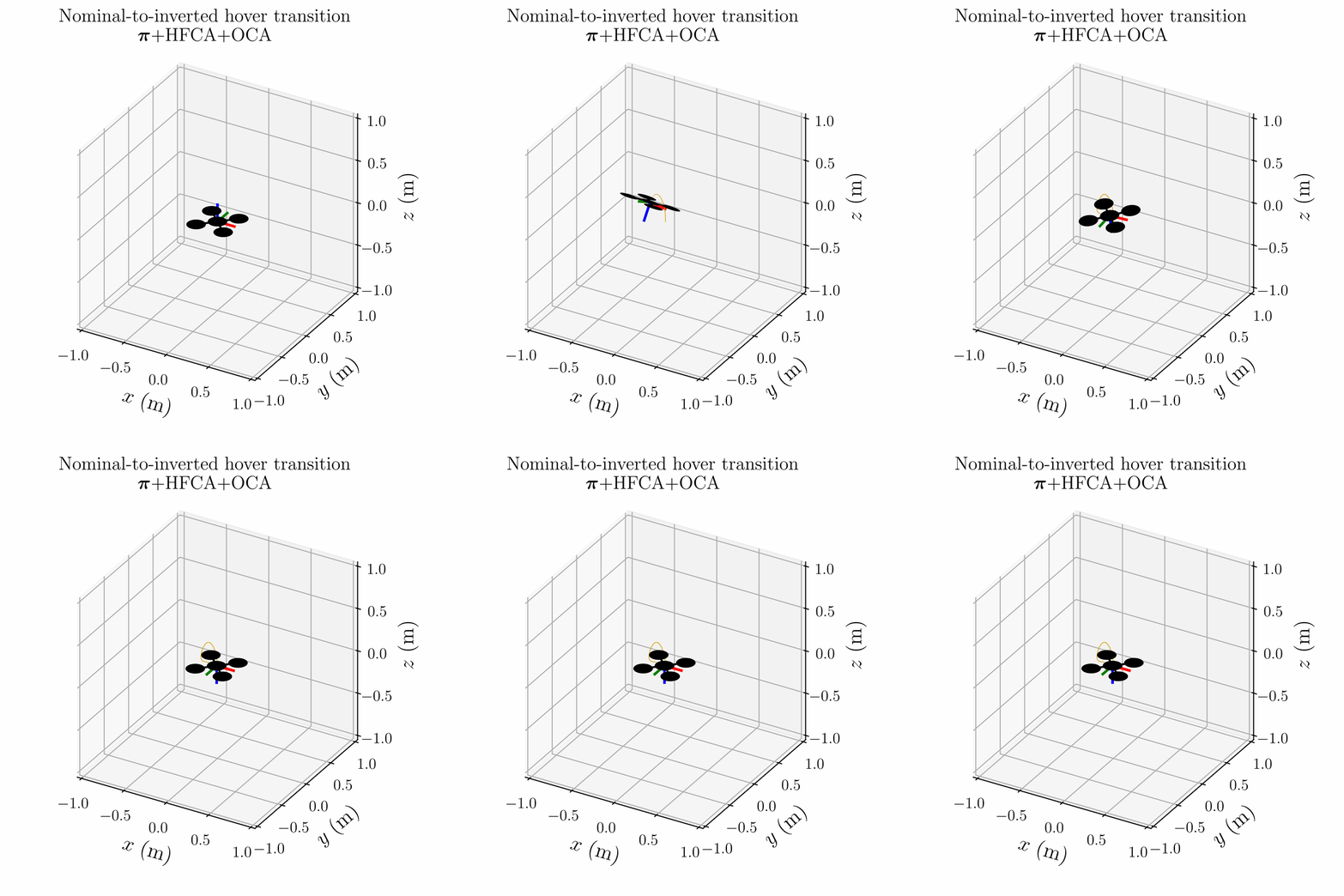
A learning-based reinforcement learning framework is proposed to enable smooth, position-constrained quadrotor inversions by modulating reference trajectories.

Abstract

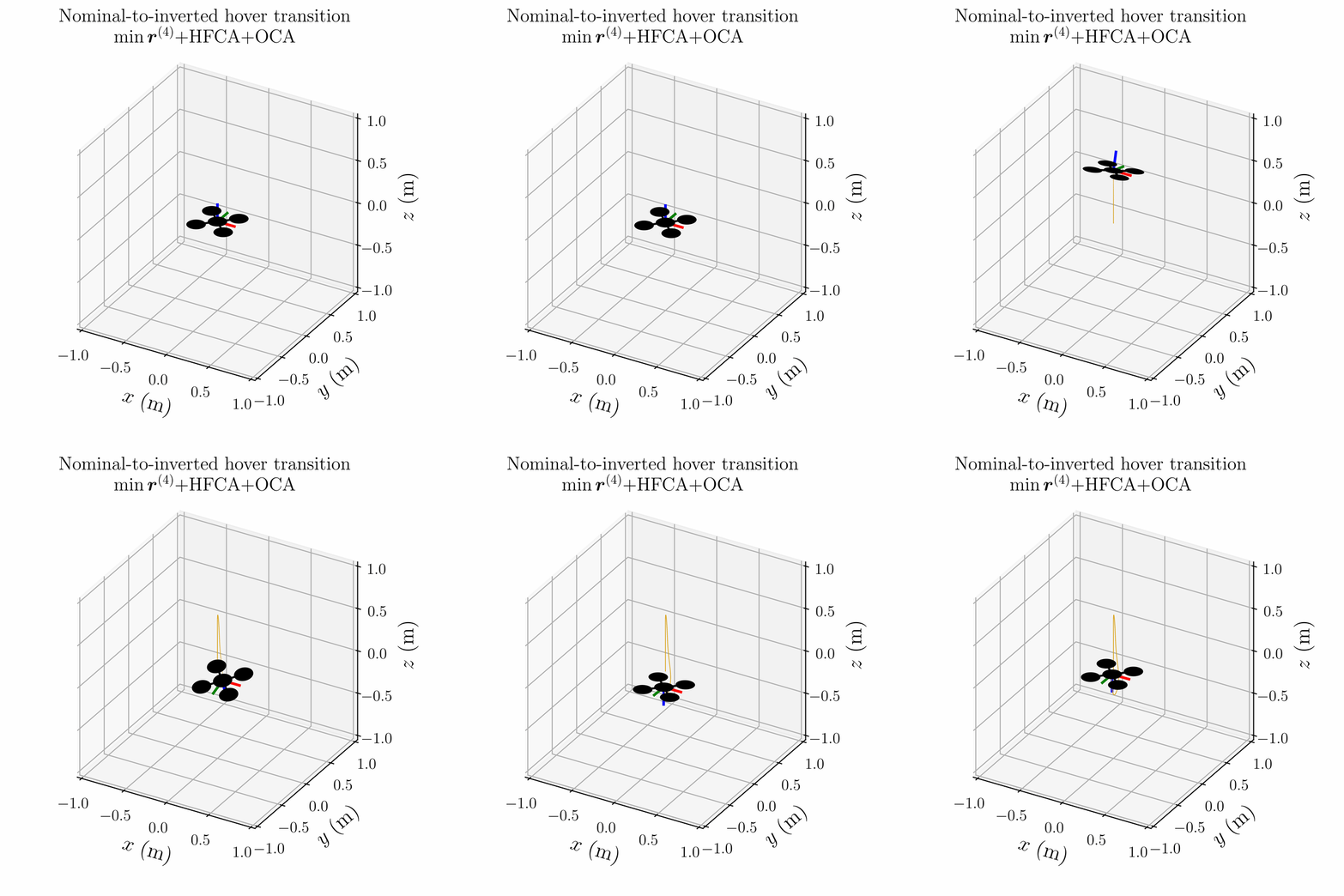
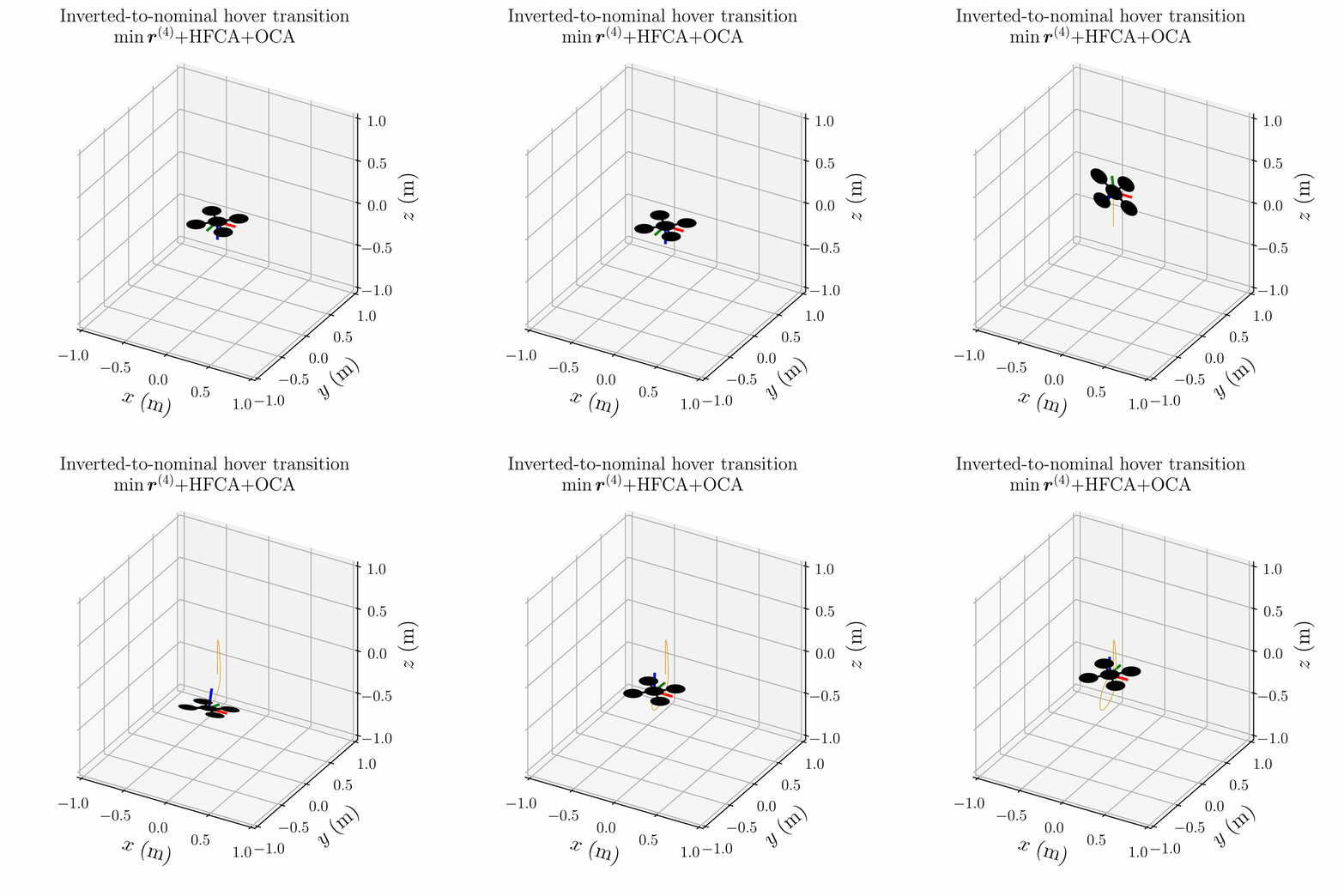
Bidirectional thrust grants quadrotors a second equilibrium condition and increased control authority, expanding the envelope of possible aggressive maneuvers and enabling inverted flight, perching, and sensing. Prior geometric control approaches extend differential flatness through Hopf fibration-based attitude representations to support bidirectional thrust, but struggle with actuator saturation and motor reversal delay during inversions, requiring heuristic thrust posture scheduling and waypoint tuning.

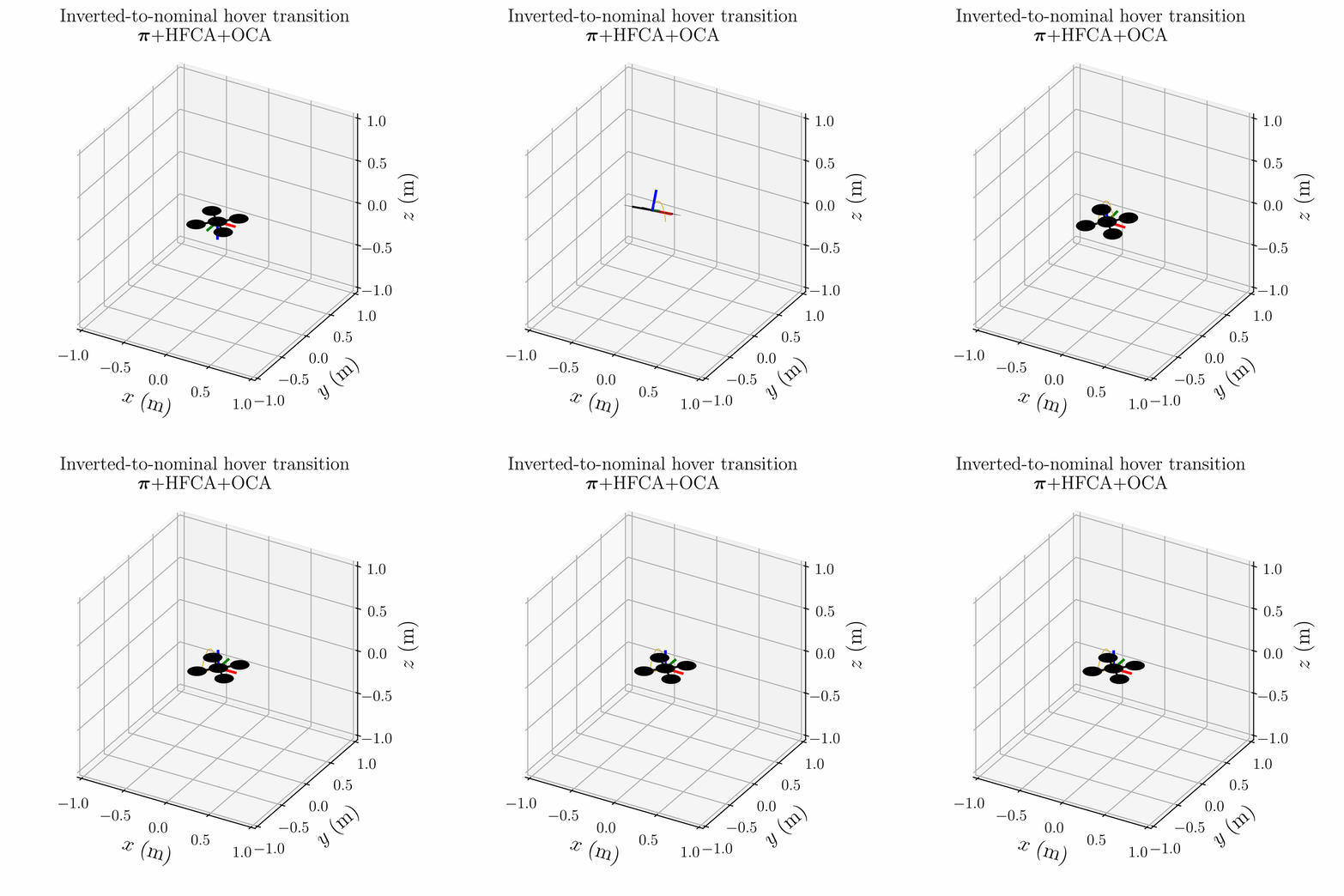
We propose a learning-based framework that modulates a constant reference trajectory to perform compact, position-constrained quadrotor inversions while remaining compatible with traditional trajectory generation and tracking across flight regimes. Separate policies are trained via reinforcement learning for nominal-to-inverted and inverted-tonominal transitions. In JAX-based simulation, the proposed method achieves the lowest positional deviation and settling time across all evaluated baselines, reducing positional RMSE by 32% and settling time by 57% relative to the strongest optimization-based baseline. Hardware experiments demonstrate successful inversion across multiple yaw configurations with positional deviation RMSE below 0.35 m, and compatibility with downstream trajectory generation and control through circular flight in both regimes.

Video

BibTeX

@article{rodriguez2026acrorl,
  author    = {Rodriguez, Gabriel and Sayag, Henri and Rathod, Abhishek and Stecklein, John and Saha, Siddharth and Barngrover, Christopher and Tabib, Wennie},
  title     = {AcroRL: Learning Aggressive Quadrotor Inversion using Bidirectional Thrust},
  journal   = {arXiv preprint arXiv:2605.24301},
  doi       = {10.48550/arXiv.2605.24301},
  year      = {2026},
}